Traditional dentures can slip, click, or feel unstable at the worst possible moments, whether you’re eating dinner with family or laughing at a joke. Implant-retained dentures solve that problem by anchoring your denture to a small number of dental implants, giving you a level of stability that a denture resting on the gums alone simply can’t match.
At Designing Smiles, we walk you through whether implant-retained dentures make sense for your situation as part of a broader look at your restorative dentistry options. Whether you’re already wearing a denture that doesn’t fit the way it used to or you’re facing tooth loss for the first time, we want you to understand every option before deciding on one.
Complete tooth loss becomes more common with age, and the numbers are more significant than many people expect. According to the Centers for Disease Control and Prevention, about 1 in 10 adults aged 65 to 74 had lost all their natural teeth as of the most recent national survey data, and that figure rises to roughly 1 in 5 among adults 75 and older. For patients facing that reality, a few common frustrations with traditional dentures tend to come up again and again:
Implant-retained dentures address each of these by giving the denture a fixed point of support instead of relying on suction and gum tissue alone, which is part of why more patients ask about this option once a traditional denture starts to feel unreliable.
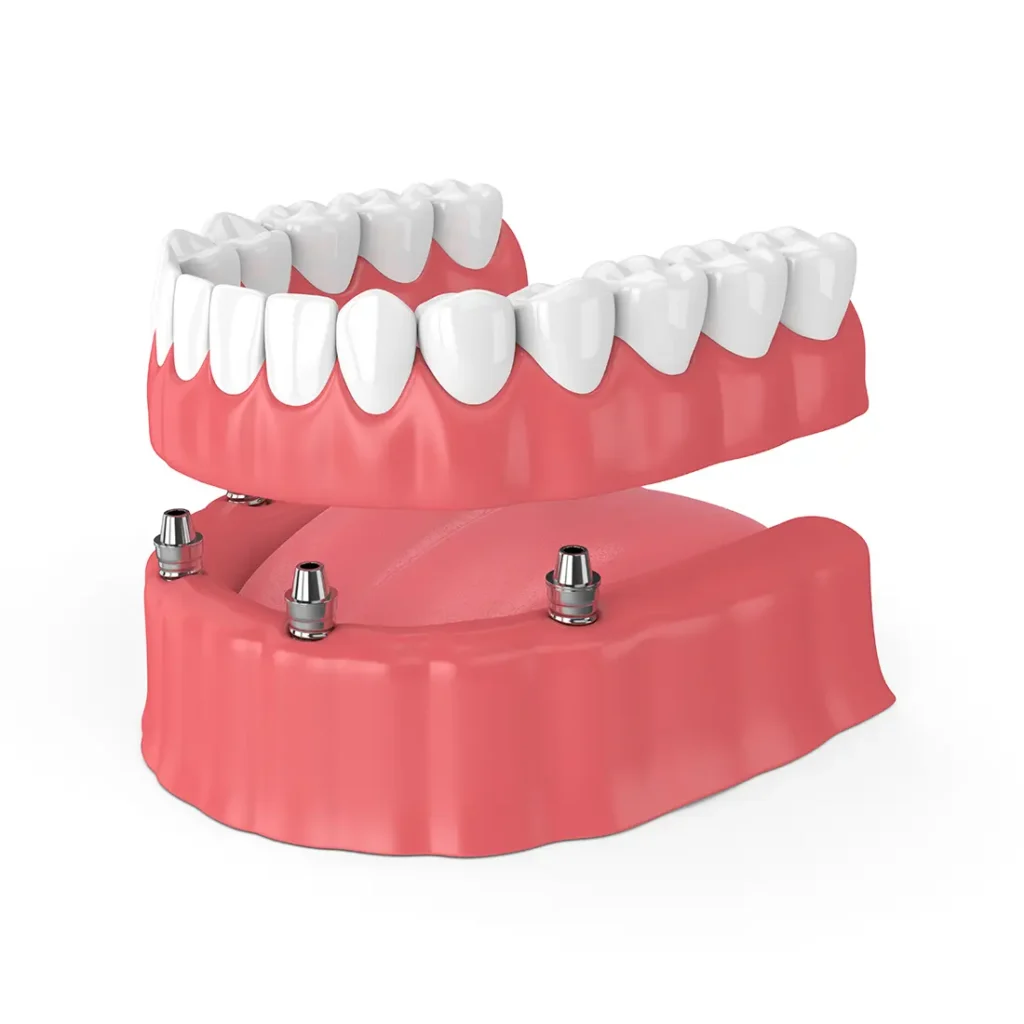
Implant-retained dentures rely on a small number of dental implants placed strategically in the jawbone, which then serve as anchor points for your denture. Rather than replacing every missing tooth individually, a handful of implants can support an entire arch, which keeps the procedure more efficient than it might sound. Once the implants have fused with the bone in a process called osseointegration, the denture snaps or clips onto the implants, giving you a secure fit you can rely on.
The number of implants needed and their exact placement depend on your jaw structure and how the denture will attach, whether that’s a bar-retained design or an attachment system built directly into the denture base. Either approach gives you far more chewing confidence than a denture held in place by suction alone. Not every patient is ready for implants right away. If the jawbone in the area has thinned from years without teeth, a bone grafting procedure can rebuild the density needed to support implants successfully. If you still have a few damaged or failing teeth that need to come out before treatment can begin, we can typically plan that extraction alongside your implant timeline so you aren’t waiting through separate, disconnected stages of care.
Implant-retained dentures aren’t the only path forward if you’re missing most or all of your teeth, and the right choice depends on your goals, your bone health, and your budget. Patients missing only some teeth, rather than a full arch, may be better suited to partial dentures instead, which don’t require the same implant placement process. Patients who want maximum stability and are comfortable with a longer treatment timeline often find implant-retained dentures worth the investment, especially if they’ve struggled with a loose or shifting denture for years.
We’ll walk through what your bone structure and remaining teeth actually support before recommending a direction, rather than assuming one option fits everyone the same way. Cost, timeline, and how much stability you’re hoping to gain all factor into that conversation, and we’d rather take the time upfront than have you commit to a solution that doesn’t match what you actually need.
Traditional dentures can slip, click, or feel unstable at the worst possible moments, whether you’re eating dinner with family or laughing at a joke. Implant-retained dentures solve that problem by anchoring your denture to a small number of dental implants, giving you a level of stability that a denture resting on the gums alone simply can’t match.
At Designing Smiles, we walk you through whether implant-retained dentures make sense for your situation as part of a broader look at your restorative dentistry options. Whether you’re already wearing a denture that doesn’t fit the way it used to or you’re facing tooth loss for the first time, we want you to understand every option before deciding on one.
Complete tooth loss becomes more common with age, and the numbers are more significant than many people expect. According to the Centers for Disease Control and Prevention, about 1 in 10 adults aged 65 to 74 had lost all their natural teeth as of the most recent national survey data, and that figure rises to roughly 1 in 5 among adults 75 and older. For patients facing that reality, a few common frustrations with traditional dentures tend to come up again and again:
Implant-retained dentures address each of these by giving the denture a fixed point of support instead of relying on suction and gum tissue alone, which is part of why more patients ask about this option once a traditional denture starts to feel unreliable.
Implant-retained dentures rely on a small number of dental implants placed strategically in the jawbone, which then serve as anchor points for your denture. Rather than replacing every missing tooth individually, a handful of implants can support an entire arch, which keeps the procedure more efficient than it might sound. Once the implants have fused with the bone in a process called osseointegration, the denture snaps or clips onto the implants, giving you a secure fit you can rely on.
The number of implants needed and their exact placement depend on your jaw structure and how the denture will attach, whether that’s a bar-retained design or an attachment system built directly into the denture base. Either approach gives you far more chewing confidence than a denture held in place by suction alone. Not every patient is ready for implants right away. If the jawbone in the area has thinned from years without teeth, a bone grafting procedure can rebuild the density needed to support implants successfully. If you still have a few damaged or failing teeth that need to come out before treatment can begin, we can typically plan that extraction alongside your implant timeline so you aren’t waiting through separate, disconnected stages of care.
We handle implant placement, bone grafting when it’s needed, and the final denture fitting all under one roof, so you aren’t bounced between separate specialists for each phase of treatment. That continuity matters in Westchase, where patients want a provider who already understands their case rather than starting the explanation over at every appointment.
We also want the cost to stay out of the way of getting care that actually improves your daily life. We accept a range of PPO insurance plans, including Delta Dental, Cigna, Aetna, and MetLife, and we offer payment plans for patients without coverage. No insurance, no problem. We’d rather help you find a workable path than have you settle for a denture that never quite fits right

Living with a denture that slips or feels unstable shouldn’t be something you just get used to. Our team keeps the process personal, whether that means implant-retained dentures, a conversation about partial dentures, or bone grafting to prepare for treatment down the road. We built this practice around comprehensive, in-house care so patients of all ages have one place to turn for every stage of their care.
If you’re in Westchase and dealing with a denture that doesn’t fit the way it should, we’re glad to talk through whether implant-retained dentures could help. You can contact our office to schedule a visit and get started.