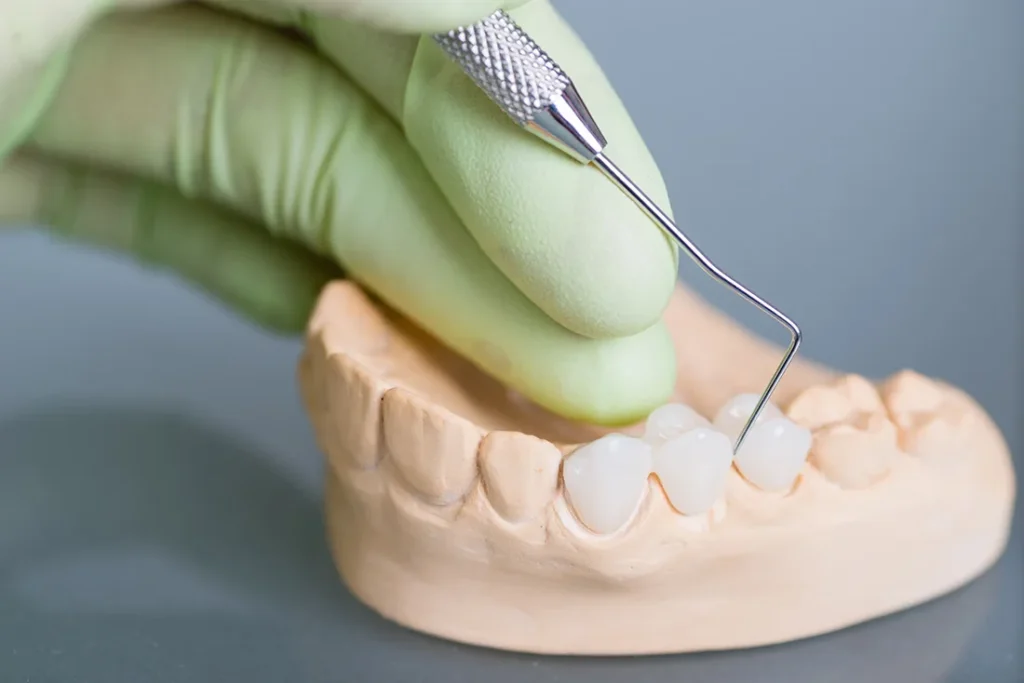
Is a missing tooth leaving a gap in your grin? Dental bridges can bridge the gap with an artificial tooth that aligns with the rest of your smile.
A gap from a missing tooth rarely stays just cosmetic. Nearby teeth can drift into the space, your bite can shift out of balance, and everyday tasks like chewing or speaking clearly can start to feel harder than they used to. A dental bridge closes that gap directly, giving you back a full, functional smile without the surgical step that an implant requires.
At Designing Smiles, we build bridges that fit comfortably and blend in with the rest of your smile, and we walk you through the process so you always know what’s happening at each visit. If you’re weighing a bridge against other restorative dentistry options, we can talk through which one fits your situation best.
Tooth loss becomes more common as people age, and it’s more widespread than many people expect. Federal data from the Centers for Disease Control and Prevention shows the share of older adults with complete tooth loss rises steadily with age, climbing from under 9 percent among adults in their late sixties to nearly 18 percent among adults 75 and older. Even a single missing tooth, left unaddressed, can set off changes that affect more than the empty space itself. A few common effects include the following:
A bridge stops that shift before it starts by filling the space with a fixed replacement tooth anchored to the teeth on either side, so the surrounding teeth stay in the position they were meant to hold.
A traditional bridge relies on the teeth next to the gap, called abutment teeth, to support the replacement tooth in the middle. We prepare those abutment teeth and place dental crowns over them, which then anchor the artificial tooth that spans the space. Once it’s in place, a well-fitted bridge functions much like your natural teeth did, letting you chew and speak without thinking twice about it.
Getting there usually takes more than one visit. At the first appointment, we prepare the abutment teeth and take an impression that’s used to custom-make your bridge to fit your bite precisely. You may wear a temporary bridge in the meantime to protect the prepared teeth, and once the permanent bridge is ready, we check the fit and bite carefully before securing it in place.
The number of teeth a bridge needs to replace, and the condition of the teeth around the gap, both play a role in planning treatment. If the teeth near the gap already have decay or weakened structure, we’ll walk you through what that means for your options before moving forward. In some cases, a tooth may need to come out before a bridge can be planned around it, and we can typically handle that extraction and the bridge planning as part of the same overall treatment path, so you aren’t left waiting between separate stages of care.
A bridge isn’t the only way to replace a missing tooth, and it’s worth understanding how it compares to the alternatives. Dental implants replace the tooth root directly in the jawbone rather than relying on neighboring teeth for support, which can be an advantage in certain cases but also involves a longer treatment timeline and a surgical step that a bridge doesn’t require. For patients missing several teeth across an arch, partial dentures offer a removable option that doesn’t require altering the surrounding teeth at all.
Which option makes the most sense depends on how many teeth are missing, the health of the surrounding teeth, and what fits your daily routine and budget. A bridge tends to appeal to patients who want a fixed solution without surgery, while an implant may be worth the longer process for someone hoping to avoid placing crowns on healthy neighboring teeth. We’ll walk through the tradeoffs with you directly rather than pushing one option over another before we understand your specific case.
We handle the full process in-house, from preparing the abutment teeth to fitting and adjusting the final bridge, so you’re seeing the same team from start to finish. That continuity matters in Westchase, where patients want a dentist who already knows their history rather than starting over with a new provider for each phase of care.
We also want cost concerns to stay out of the way of getting the care you need. We accept a range of PPO insurance plans, including Delta Dental, Cigna, Aetna, and MetLife, and we offer payment plans for patients without coverage. No insurance, no problem. We’d rather help you find a workable path forward than have you delay treatment over cost alone.
A missing tooth doesn’t have to mean living with a gap or the problems that come with one. Our team keeps the process straightforward, whether that means a single bridge, a conversation about implants, or exploring partial dentures for multiple missing teeth. We built this practice around comprehensive, in-house care so patients of all ages have one place to turn for the full course of treatment, and we take the time to make sure you understand each step before we move forward.
If you’re in Westchase and dealing with a missing tooth, we’re glad to talk through what a bridge might look like for your specific case. You can contact our office to schedule a visit and get started.